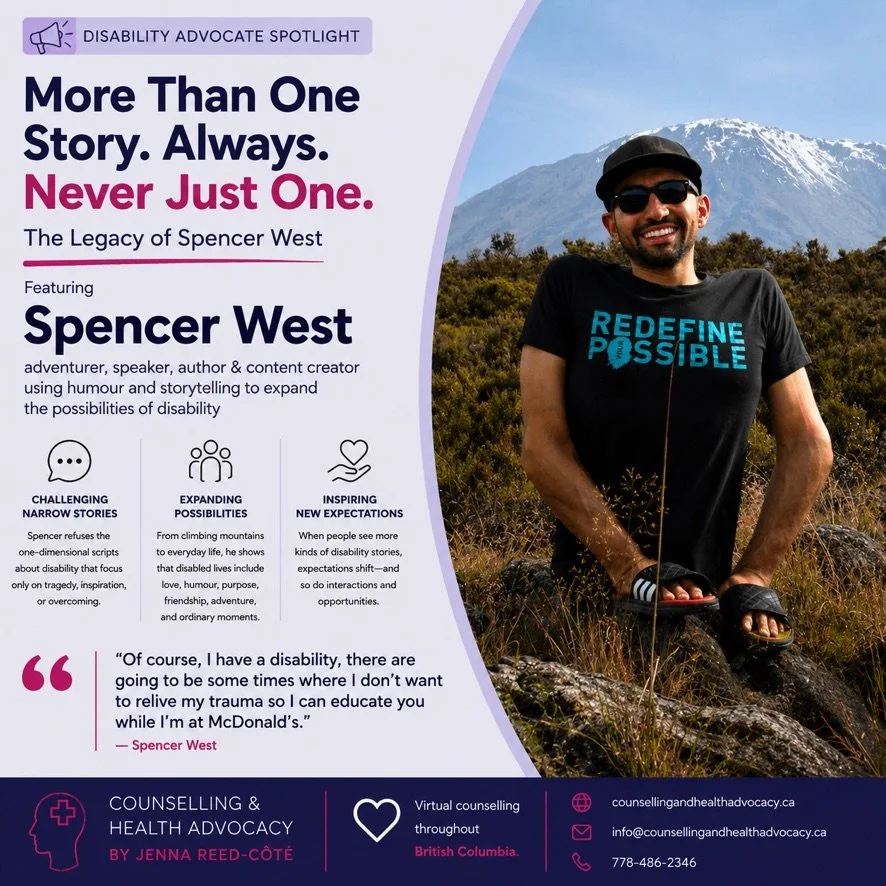
Most disability stories follow a familiar script.
Someone becomes disabled. Something terrible happens. Then, if it's a "good" story, they overcome it. Or they inspire everyone around them. Or they exist to teach the audience a lesson about gratitude.
Spencer West has spent years quietly refusing that script.
Not because disability isn't difficult. Not because barriers don't exist. But because disabled lives have always been bigger than the stories we've been told about them.
When you spend time with Spencer's work, something interesting happens. Sometimes he's talking about climbing Mount Kilimanjaro. Sometimes he's answering questions about how he goes to the bathroom. Sometimes he's talking about dating, friendship, confidence, or setting boundaries with strangers who ask deeply personal questions.
The topics couldn't seem more different.
But together, they quietly challenge the idea that disability only gets to have one kind of story.
By the end, you haven't just learned something about Spencer. You've started expecting different kinds of disability stories.
Who is Spencer West?
Spencer West is a Canadian disability advocate, speaker, author, and content creator who was born with sacral agenesis. After having both legs amputated in early childhood, prosthetic legs were never an option for him. Today, through his speaking, writing, and online content, he uses humour, honesty, and storytelling to challenge assumptions about disability.
Many people first heard of Spencer after he climbed Mount Kilimanjaro—completing much of the ascent on his hands while raising awareness and funds for clean water projects in East Africa.
It's an extraordinary achievement. But I don't think it's what makes his advocacy unique.
His real contribution is much quieter.He changes the kinds of disability stories people expect to hear.
He Doesn't Correct Assumptions.
He Replaces Them.
Many forms of disability advocacy begin by correcting misconceptions. Spencer often begins somewhere else.
He invites people into his everyday life. He makes them laugh. He answers questions people have been wondering about.
Sometimes they're practical. Sometimes they're deeply personal. Sometimes they're questions many disabled people wish they weren't asked so often. Sometimes they're all three at the same time. But instead of responding with shame or defensiveness, Spencer responds with warmth, humour, and honesty.
One of my favourite examples is a video where he explains how he goes to the bathroom.
Now...I realize that's probably not where you expected this article to go. That's kind of the point.
Most people have never had an opportunity to ask those questions respectfully. Spencer recognizes that curiosity exists. He doesn't pretend otherwise. Instead, he teaches something much more important. Curiosity isn't the problem. Entitlement is.
There's a difference between asking questions because someone has invited you into a conversation...and assuming you're entitled to intimate details about a stranger's body.
That distinction matters.
Not just for disabled people. For everyone.
What Spencer Changed
Representation shapes expectations. And expectations shape behaviour.
For decades, disability has often been portrayed in remarkably narrow ways. As tragedy. As something to overcome. As inspiration for non-disabled people. As a plot device.
Spencer tells different stories. Stories about dating. Friendship. Joy. Purpose. Embarrassing moments. Bad days. Travel. Success. Ordinary life.
He also shares disability history that many people have never heard before—like explaining that hot tubs and electric toothbrushes were originally developed to meet disabled people's needs before benefiting everyone else.
Something subtle happens when people encounter those stories often enough. They stop expecting disability to fit one narrative. And when expectations change...interactions begin changing too.
What Does This Have to Do with Disability-Affirmative Therapy?
One of the things I love about disability-affirmative therapy is that it encourages us to become curious—not only about barriers, but about the stories people have been taught to believe.
When a disabled client says, "People always seem surprised that I have a partner." Or, "They're shocked that I live on my own." Or, "Everyone assumes someone else makes my decisions."
The question isn't only, "What expectations were already present before anyone said a word?"
It's also, "What expectations did you begin having for yourself after hearing those messages for years?"
Because expectations don't only shape interactions. Over time...they can begin shaping identity.
If you've rarely seen disabled people fall in love...lead organizations...travel the world...be funny...be ordinary...or simply live full, complicated lives...it's not surprising if some possibilities become harder to imagine for yourself.
That's why representation matters. It doesn't simply change what other people expect. Sometimes it expands what disabled people believe is possible too.
The Stories We Never Got
I think one of Spencer's greatest contributions is that he gives disabled people something many of us didn't grow up with. Possibility. Not impossible expectations. Not toxic positivity. Possibility.
The possibility that disability and humour belong together. That disability and love were never opposites. That disability and confidence don't cancel each other out. That disabled lives have always been allowed to be messy...funny...ordinary...ambitious...complicated...and joyful.
Those stories have always existed. We just haven't always been told them.
Those stories matter. Because we can't imagine ourselves into futures we've never seen.
Why Spencer Matters
Spencer West didn't simply climb a mountain. He expanded the kinds of disability stories people believe are possible. And that matters because stories don't just entertain us. They quietly teach us what to expect.
Disability-affirmative therapy asks us to pay attention to those stories. Not because every story changes a life. But because enough different stories...told often enough...can change what someone believes is possible for themselves. Because when the stories we tell about disability become bigger...the lives we imagine become bigger too. And I wonder if that's where change begins.
Not by changing disabled people. But by changing the stories we've been telling about them all along.