

Disability-Affirmative Therapy for teens and adults for physical disabilities and chronic illness
Understanding First. Then Tools That Fit.
Living with a physical disability or chronic illness can affect much more than your body. Constantly adapting, anticipating accessibility, navigating healthcare, managing changing capacity, or feeling like you have to prove your needs can take an emotional toll.
Disability-Affirmative Therapy offers a place to understand that impact and develop practical tools for:
anxiety
depression
emotional regulation
burnout
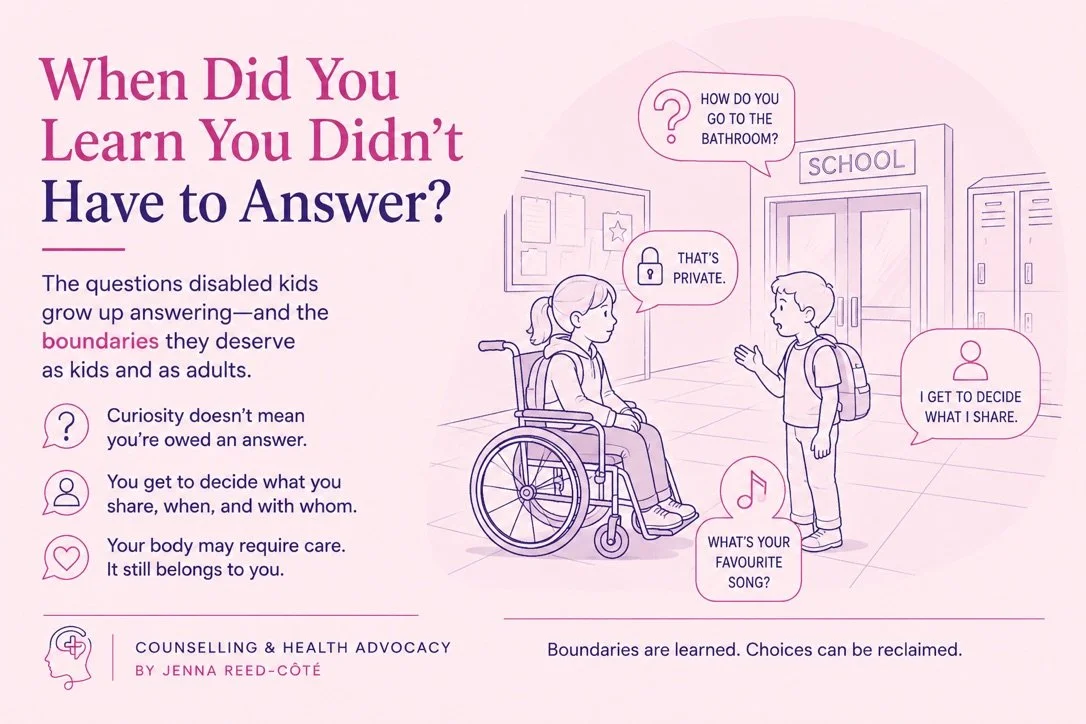
boundaries
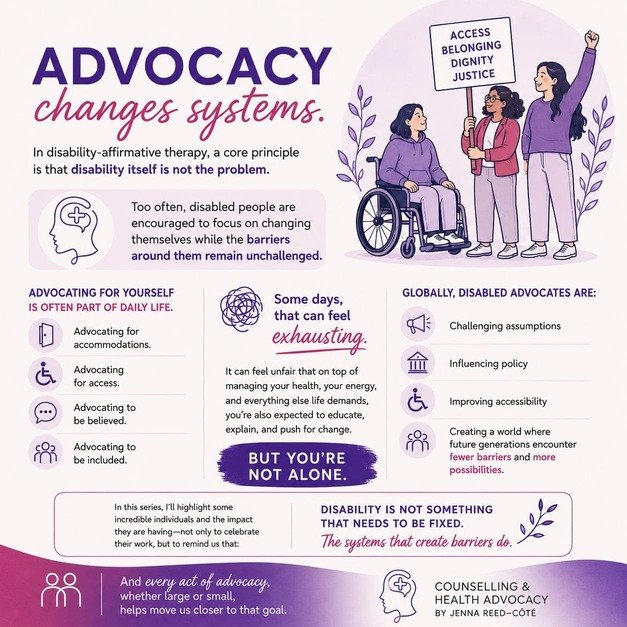
self-advocacy
and more.

Perhaps You've Been Carrying More Than People Realize
You're Exhausted From Constantly Adapting
Managing pain, fatigue, appointments, accessibility, transportation, other people's expectations—and all the planning nobody else sees.
Going Out Can Feel Like Work
Before saying yes, you're already wondering about entrances, bathrooms, transportation, seating, energy, pain, and whether you'll have to ask someone to change the plan.
You're Tired of Advocating
Explaining the same needs. Asking for accommodations. Following up. Preparing yourself to be questioned. Sometimes wondering whether speaking up is even worth it anymore.
You Feel Guilty for Needing Help
Maybe you've started wondering whether you're asking for too much, inconveniencing other people, or should just be able to push through.
Your Emotions Feel Harder to Manage
Anxiety, anger, sadness, grief, overwhelm, or shutting down may be showing up more often—and perhaps you've been told you're "too sensitive."
You're Wondering Why You're Not Coping Better
Especially when you've spent years being told how resilient, capable, or adaptable you are.
What If You're Not Failing to Cope?
Many disabled people have been adapting their whole lives.
Sometimes the question isn't:
“Why am I not coping better?”
It's:
“What has all this coping been costing me?”
Living in environments that weren't designed with your needs in mind can mean constantly planning, anticipating, explaining, adapting, advocating, and recovering.
Over time, those experiences can affect how safe you feel, what you expect from other people, what you believe you're allowed to need, and even how you see yourself.
Disability-Affirmative Therapy makes room to understand that context—not just the symptom that brought you to therapy.

How Disability-Affirmative Therapy Can Help
1. Understand What's Underneath the Symptom
If you're anxious, depressed, isolated, exhausted, or overwhelmed, we'll work with those concerns—but we won't assume the symptom tells us the whole story.
We'll also get curious about what you've experienced and what your mind and body may have learned from it.
2. Develop Tools That Fit Your Life
Therapy can include practical strategies for anxiety, depression, emotional regulation, grounding, boundaries, burnout, and difficult thoughts.
The goal isn't to make you fit the tool. It's to find and adapt approaches that make sense for your disability, energy, capacity, and circumstances.
3. Question What You've Learned About Yourself
If you've repeatedly been made to feel difficult for needing accommodations, you may start believing you're a burden.
If you've been praised for pushing through, resting may feel like failing.
Together, we can notice where those beliefs came from and decide whether you still want to carry them.
4. Strengthen Your Voice
We can work on boundaries, accommodation requests, healthcare conversations, and self-advocacy—including role-playing difficult conversations before you have them.
5. Build a Life That Works for You
Rather than measuring progress against what you think you should be able to do, we can explore what connection, participation, rest, relationships, meaning, and well-being look like for you.
When the Symptom Isn't the Whole Story

Suppose you tell me:
“I'm exhausted. I barely go out anymore. I'm starting to lose hope.”
We might explore depression.
But I'll also want to know:
Are you staying home because going out requires researching accessibility, managing pain or fatigue, or worrying about being a burden if plans need to change?
Are you exhausted because you're constantly anticipating barriers other people rarely have to think about?
Are you losing hope because you've advocated again and again without much changing?
That context matters.
Telling you to get out more isn't particularly helpful if getting out repeatedly means encountering inaccessible spaces.
So before asking only:
“How do we change this?”
we can also ask:
“What has happened that makes this response understandable?”
Then we can choose tools that actually fit.
What Sessions Actually Feel Like
Disability-Affirmative Therapy isn't an hour of talking about everything that went wrong that week and then sending you back out to deal with it again.
Sessions are collaborative and purposeful, while leaving room for whatever your capacity looks like that day.
Some weeks we may unpack an experience that's still affecting you. Other weeks we might practise an upcoming conversation, work with anxiety, explore a difficult belief, develop an emotional regulation strategy, problem-solve a barrier, or figure out how to protect your energy without feeling guilty about it.
Understanding your experience is important. So is helping you decide what you want to do next.
What to Expect in Your First Session
Your first session isn't about proving how much your disability affects you or arriving with perfectly defined therapy goals.
We'll talk about what's bringing you to therapy, what life actually looks like right now, what's been hardest, what you've already tried, and what you would like to be different.
We'll begin making connections between what you're experiencing and the broader context of your disability, relationships, environment, healthcare experiences, and daily life.
From there, we decide together where the work goes next.
Check out our recent blog posts on Disability-Affirmative Therapy

About Counselling & Health Advocacy by Jenna Reed-Côté RSW, MSW

Sometimes the hardest part of living with a disability isn't only the disability itself.
It's living in a world that often mistakes barriers for limitations.
It's everything that grows around that misunderstanding.
And the quiet question of whether you're allowed to need what you need.
After years of adapting, explaining, minimizing, and trying not to be "too much," many disabled people begin questioning themselves instead.
Not because they're weak.
Not because they're failing to cope.
But because they've spent so long living in environments that asked them to adapt rather than asked whether the environment itself needed to change.
That's the lens I bring to therapy.
Living with a physical disability has taught me that the emotional impact of disability is often about much more than a diagnosis. It can be about navigating inaccessible systems, medical trauma, other people's assumptions, and the quiet pressure to keep adapting, even when adapting is costing you.
It's not my job to tell you what your experiences mean.
It's my job to understand what they mean to you.
I became a therapist because I wanted to be one of the helping professionals I desperately needed growing up.
For a long time, I thought the answer was to keep adapting.
What changed my life wasn't learning how to adapt better.
It was realizing that some of what I had been carrying was never mine to carry in the first place.
That realization continues to shape how I work today.
Before we talk about coping strategies, I want to understand what you've been carrying, how it came to feel like yours to carry, and what it has cost you.
Together, we'll explore what's weighing on you, recognize what may never have belonged to you in the first place, and build practical strategies that honour your needs, values, and capacity.
Outside the therapy room, I've spent years advocating for accessibility and inclusion. I've been a Rick Hansen Foundation Ambassador since 2017, and in 2021 I led the Vancouver team participating in AccessNow's accessibility mapping project, contributing to the largest accessibility survey ever conducted in Canada.
Most importantly, I want you to know this:
You do not have to prove you're struggling enough before you deserve support.
If something is affecting you, it matters.
And if you're wondering whether therapy could help, I'd be honoured to walk alongside you.
Perhaps you're considering Disability-Affirmative Therapy but still have some questions...
I've felt dismissed and unheard by healthcare providers. Will therapy feel similar?
I'm sorry you've had those experiences. Unfortunately, many disabled people can relate.
Therapy with me isn't about proving your experiences or convincing me they're real. It's about understanding how those experiences have affected you and working together toward the goals that matter most to you.
There may be times when I gently challenge a thought or offer another perspective, but that's very different from questioning your reality, minimizing your experiences, or dismissing your needs.
What if my family, caregiver, or healthcare team disagree with what I want from therapy?
That can be incredibly difficult.
When several people are involved in your care, it's common for everyone to have different ideas about what's best.
My role isn't to decide for you.
It's to help you better understand your own needs, values, goals, and boundaries so you can make decisions that feel right for you and communicate them with confidence.
Do you only focus on my disability or chronic illness diagnosis?
No.
Disability may be an important part of your life, but it is only one part of who you are.
We might talk about disability, chronic illness, relationships, grief, burnout, identity, self-worth, advocacy, life transitions, or something completely different.
Wherever our conversations take us, my goal is to support you as a whole person—not simply as a diagnosis.